

A stock market drop in your first year of retirement can feel frightening, and I understand why. In fact I’ve seen this fear keep many from retiring entirely.
And yet Michael Kitces studied historical retirements and found that even a 42% first-year drop in stocks still supported a starting withdrawal rate of about 5.3% for a 60/40 portfolio. That is above the 4% rule.
It’s the first ten years that deserve more of your attention.
Kitces found that the first year’s return had little connection to how much a retiree could safely spend. The strongest connection was the first ten years of returns after inflation.
Why? With a diversified portfolio, one year of withdrawals can come from the bond side while stocks recover. After ten slow years, there is far less left to rebuild.
Morningstar’s simulations point the same way. Nearly 70% of the retirements that ran out of money had a portfolio balance smaller in year 5 then when they started. Retirees who reached year five with gains had roughly a 1-in-25 chance of running out later.
Big difference.
That test used an all-stock portfolio, so a mix of stocks and bonds may do better.
Let’s look at an example with simple numbers. You have $1 million, a $40,000 first-year withdrawal (4%), and a 2.5% raise each year for inflation.
Over 30 years the portfolio earns 1% a year for one decade, 7% for another, and 11% for the third. Poor in this example is defined as the decade earning just 1% per year.
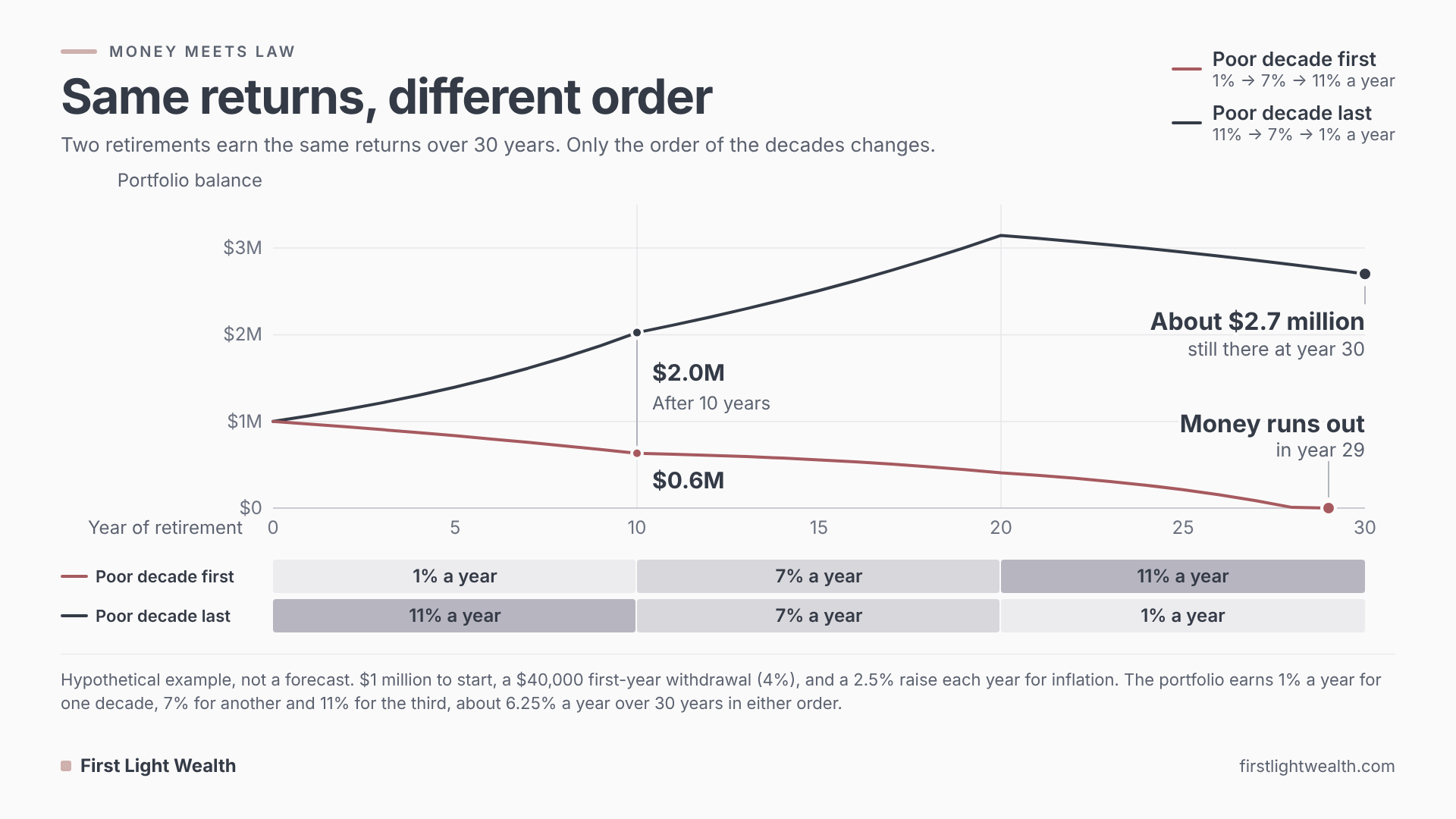
The returns are identical. Only the order changes.
Both earned about 6.25% a year over the 30 years. I call this sequence of returns risk, and it means the order of the market’s ups and downs can matter as much as the average. Money withdrawn during a slump never gets to join the recovery, unlike your working years when the market dips were often opportunistic to those funding a 401k every 2 weeks.
No one knows which order we will get. That is why the 4% safe withdrawal rule was built around the worst starting years in history, and I wrote about what its creator says now.
A dynamic spending plan adjusts what you take out based on what the portfolio is doing. Morningstar tested several of these approaches, and every one supported a higher starting withdrawal rate than a fixed, inflation-adjusted amount.
The general premise is that a pre-defined framework allows you to make small adjustments to your withdrawals (i.e. your spending) during market downturns as well as strong periods of positive performance.
Let’s go back to the poor-decade-first example. Say you trim spending by 10% for the first ten years, about $4,000 in year one or roughly $333 a month, then return to the original plan. The money lasts all 30 years, with about $84,000 left.
Trimming for only the first five years was not enough. The money ran out in year 30. Over the full decade, the trim adds up to about $45,000 of spending given up.
I held the trim for all ten years to keep the math simple. In reality the plan should respond to what the markets actually do. It’s quite possible that a spending cut may only be warranted for a few years if a strong period of growth follows the decline and therefore allows the portfolio to recover.
Again, the 10% is just an example. Your numbers may be different. Just trying to convey a principle here.
Simple guardrail rules can call for deeper cuts than many retirees expect when weak markets linger. Derek Tharp and Justin Fitzpatrick showed this on Kitces.com in 2024, and it is why I like risk-based guardrails in our financial planning practice, which I covered in last week’s edition. They look at the whole plan, so planned changes like Social Security starting do not set off a false alarm.
Part-time income in the early years can ease the same pressure. I wrote about that in The Case for Retiring Gradually.
Put your first ten years of retirement on one page. For each year, list what you expect to spend and where the money comes from: portfolio, Social Security, a pension, part-time income. Then circle the years with the most room to flex.
That page shows how much cushion you have if the early years go poorly. A bad first year feels a lot less scary when you know what you would do about it ahead of time.
If you would like help mapping your first ten years, grab a time here.
Cheers,
David
One short email a week on the money, taxes, and personal side of stepping away from the law.

Financial Advisor


Financial planning & investment management services for families & businesses
📍405 E Chocolate Ave, Suite 101 A, Hershey, PA 17033
Serving clients virtually nationwide