
%20(1).png)
The last few weeks we’ve looked at some retirement scenarios that all assumed the same thing. You work full time on a Friday and you're finished on Monday.
It's the version most attorneys picture when they imagine retiring. It's also the version that can be terrifying (Might even have you wishing to get those Sunday scaries back).
So let's run a version of retirement that isn’t cold turkey.
Let’s revisit the couple in our episode a few weeks back:
$3 million in investable assets
$72,000 of Social Security
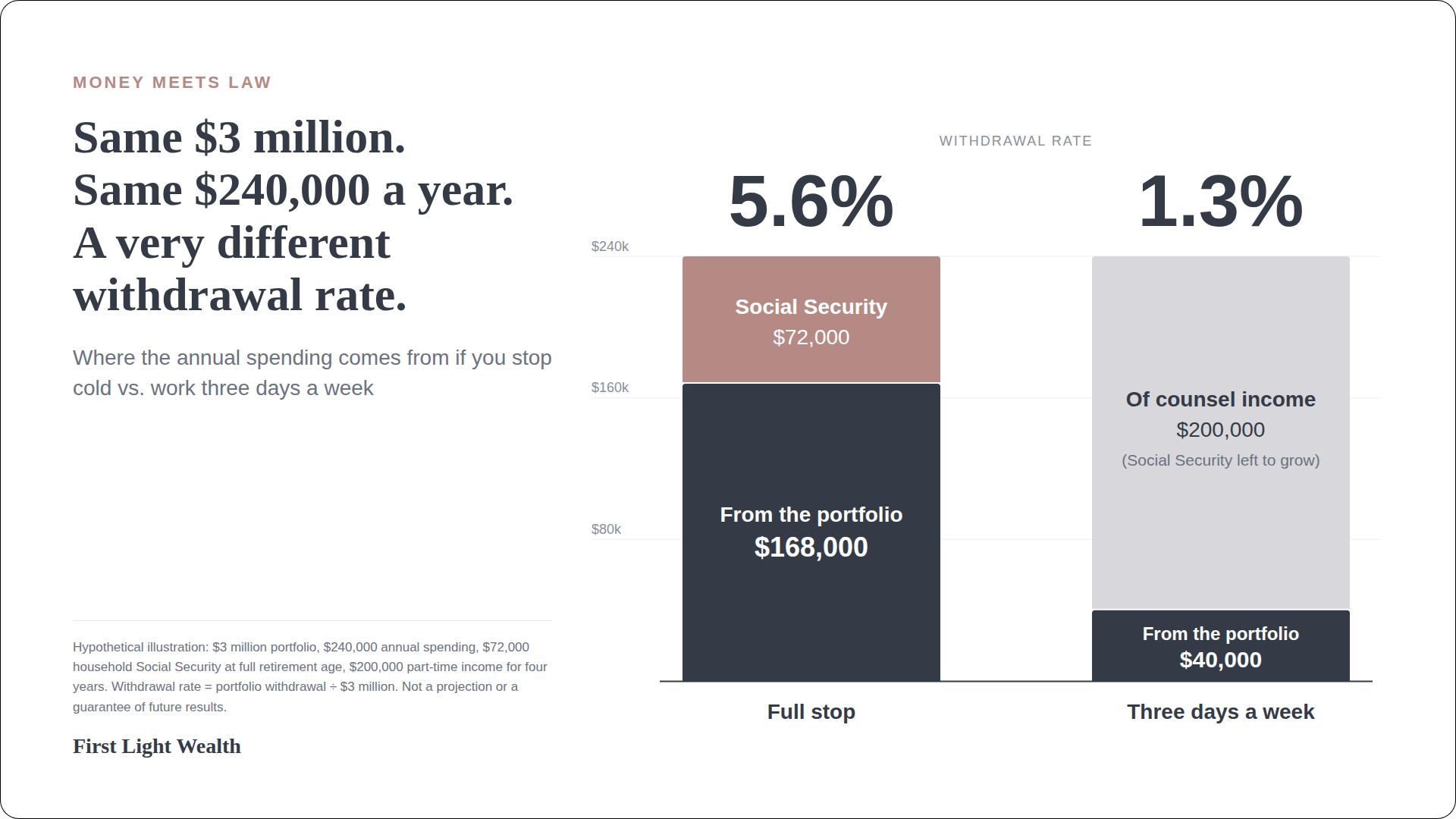
A $168,000 gap (“Gap” = The difference between your total gross expenses of $240,000 and stable income sources of $72,000)
It all translates to a 5.6% withdrawal rate ($168,000 divided by portfolio balance of $3M)
Now say this attorney goes of counsel instead of stopping cold turkey. Three days a week, $200,000 a year, for 4 years, with Social Security left to accrue for now.
That leaves about $40,000 of spending for the portfolio to cover or a 1.3% withdrawal rate instead of 5.6%. Same $3 million, same life, but a much different result.
The impact this can have early in the portfolio’s life is more significant than you might think.
A portfolio that takes a bad market in year 2 while you're pulling $168,000 out of it may never make up the ground. That same bad market in year 20, after two decades of growth, is something a plan can absorb.
The early withdrawals are the most fragile in retirement. Working part time protects them without you changing a single thing about how you're invested.
At full retirement age our attorney collects $4,000 a month. Every year of waiting past that adds roughly 8%, so by 70 the household's $72,000 may be closer to $90,000, inflation adjusted for the rest of both their lives.
Waiting is hard when the only way to fund the wait is your portfolio. Part time income makes that choice a lot easier, and delaying may be one of the more durable improvements available to a plan like this one.
Four years later the portfolio has been left largely alone and the guaranteed income is bigger. The withdrawal rate you're staring at is a very different number than the one you started with.
This next piece would matter to me even if none of the numbers moved the needle.
You’ve spent a lifetime being the one people call when they need help, answers, or reassurance. That's a hard thing to hand back full-stop on a Friday afternoon. A gradual exit lets you find out what the next chapter looks like while you still have the old one to stand on.
I've written before about finding purpose beyond practice, and it's the harder half of this decision for most of the attorneys I work with. The analytical mind, the problem solving, the instinct to help someone in trouble. All of that transfers. Figuring out where it goes takes time, and part time work gives you that time on your own terms.
Maybe you know exactly what your next endeavors will be, and that’s great if so. But for many it’s a challenging transition. It’s ok to ease into it and explore retirement one step at a time.
We started with a simple question a few weeks back. Is $3 million enough?
The honest answer is that it depends on what your life costs, what income shows up without you, how willing you are to adjust when markets turn, and how you're invested.
And it depends on whether you have to stop all at once, which you probably don't.
What you're funding is a life that still uses what you're good at, without the billable hours attached. The money question and the purpose question turn out to be the same question.
If any of this resonated, I'd like to know where you are in the process. Just reply to this email and let me know.
Cheers, David

Financial Advisor


Financial planning & investment management services for families & businesses
📍405 E Chocolate Ave, Suite 101 A, Hershey, PA 17033
Serving clients virtually nationwide