
.png)
I don't track my grocery spending. I couldn't tell you what I spent on gas last month.
Somewhere in my 30s I quit the spreadsheet, and I've never gone back.
So when I sit down with an attorney getting close to retirement, ask what they spend in a year, and they look at me like I asked them to recite their high school locker combination, I get it. Budgeting was something you did before you made partner. Wasn't the whole point of building the career to stop counting?
Here's my problem. That number is the one that decides everything else.
We run a 5-step process here at First Light. Purpose comes first, because I need to know what actually matters to you before I know what to build. Income comes second. The portfolio comes third.
That order is deliberate. If I don't know what you're pulling out of the portfolio every month, I'm guessing at how to build it. And I'd rather not guess with your retirement.
Let's say you retire with $2,000,000, we earn 7% a year, and your spending rises 3% annually for inflation.
At $10,000 a month, that money lasts about 27 years.
At $13,000 a month, it lasts about 18 years.
A difference of $3,000 a month costs you a decade.
10 years. Same portfolio, same returns. The only thing that changed was spending.
Chances are you've spent more time deciding which index fund to own than you have thinking about that $3,000. I'd like to flip that.
The honest way to find your number is to go get it. Pull 12 months of credit card and bank statements. Log into whatever banking portal you've been avoiding. Categorize all of it.
We built a tracker for exactly this, and the clients who use it end up with a genuinely accurate picture (Not to mention beautiful):
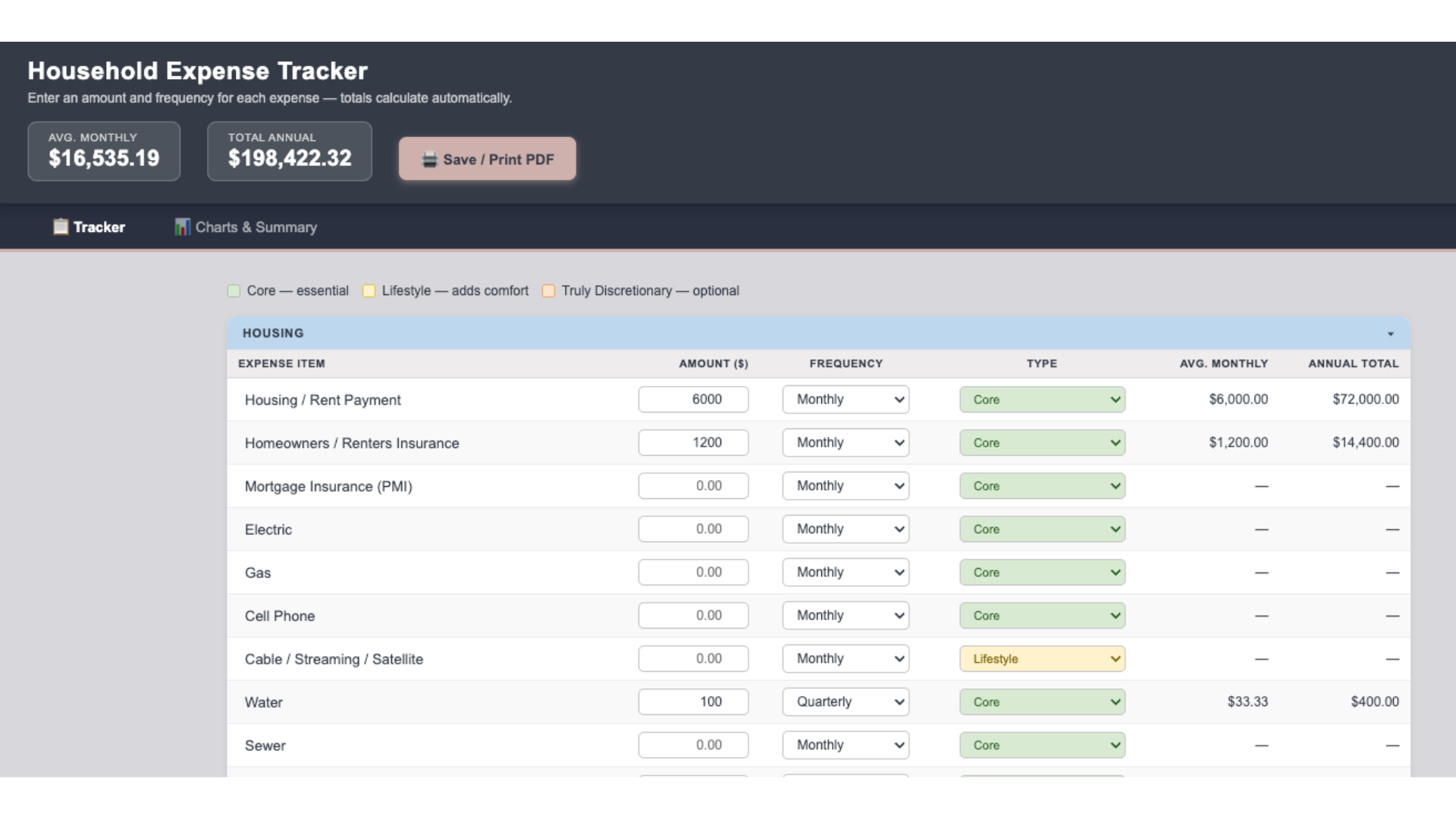
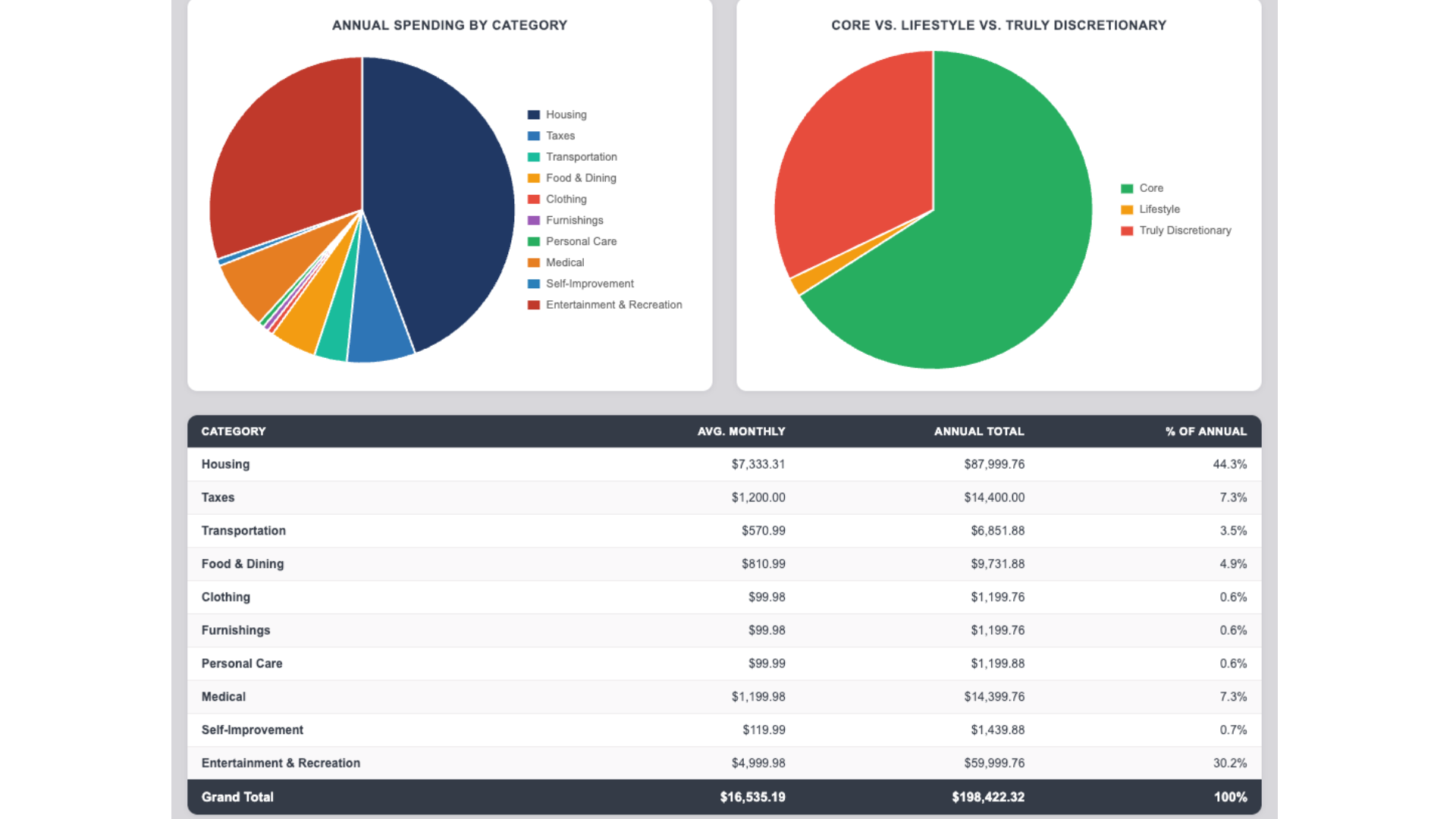
Once you've entered your expenses, the tool automatically totals and organizes them by category. It also generates easy-to-read pie charts that break down your spending by category and show how much goes toward core, lifestyle, and truly discretionary expenses.
I also know how this exercise can sound.
Believe me, I know nobody wants to hear a financial advisor suggest they go categorize 14 months of Amazon charges. I wouldn't do it either.
Take your total income. Subtract everything you saved. Subtract every dollar of tax you paid.
What's left is what you spent.
It won't be perfect. It'll be close, and close is a good place to start.
You already have all 3 numbers sitting in a drawer. Your W-2 or K-1 has the income. Your statements have the savings. Your tax return has the taxes. 20 minutes with 3 documents beats 3 weekends with a shoebox of receipts.
That number is a starting point, and we don't stop there.
Taxes look different once the paychecks stop, so I never assume that $200,000 of gross income today means $200,000 in retirement. Your mortgage may fall off. Your hobbies may get more expensive, or you may finally have the time for the ones you've been putting off.
Those adjustments are easy to make once we have a real baseline. Guessing at the baseline is what gets people in trouble.
I know what you're thinking. A few paragraphs ago $3,000 a month cost you 10 years of retirement. Now I'm telling you "close enough" is fine.
Fair. Let me clear that up.
Both of those are true because your spending number isn't supposed to sit still. We set the baseline once, and then we revisit it every single year against what the portfolio actually did.
Good years, we adjust up. You take the extra trip. You help with the grandkids' tuition. That's what the money was for.
Rough years, we trim a bit. Maybe the kitchen renovation waits 18 months. It's usually a small adjustment, and it's a whole lot easier to make a small one on purpose than a large one under pressure.
The $3,000 example matters because it shows how much leverage you have. The "close enough" matters because you're going to recalibrate anyway. Getting the starting point roughly right and then steering is far better than getting a precise number in year 1 and never touching it again. I've written more about that here: Why Dynamic Spending Is Your Best Asset.
Get close enough to the truth about what you spend, and then let it move with your life. You can go spend it without wondering in the back of your mind whether you're allowed to.
That's the guilt-free part. It has very little to do with budgeting.
If you want the expense tracker we use with clients, just reply to this email with the word "tracker" and I'll send it over.
That's it for this week. Thanks for reading.
-David

Financial Advisor


Financial planning & investment management services for families & businesses
📍405 E Chocolate Ave, Suite 101 A, Hershey, PA 17033
Serving clients virtually nationwide