

Nearly 14% of lawyers in the U.S. are 65 or older, as reported by the 2023 ABA Profile of the Legal Profession. For all other workers that figure is about half: 7%.
Attorneys stay.
Sometimes because they love the work, sometimes because the firm has no one else to take the clients, sometimes because stopping feels like disappearing.
The ones who exit well, financially and otherwise, tend to share one thing. They started the conversation years before they wanted to be done.
Consultants interviewed by the ABA Journal said many smaller firms have no written protocol for moving older partners out and younger lawyers into leadership. Partnership agreements may address incapacitation, but the actual handoff rarely gets written down anywhere.
Firms that do it well tend to run two to three-year transition plans. Some older lawyers stay on as nonequity or contract attorneys during that stretch, which gives clients continuity and gives the new face time to get established.
The money side of a phased exit rarely gets written up anywhere, which is where I spend most of my time with clients.
A hard retirement is a clean model. One day you are earning, the next day you are not, and the plan builds from there.
A phased exit works differently.
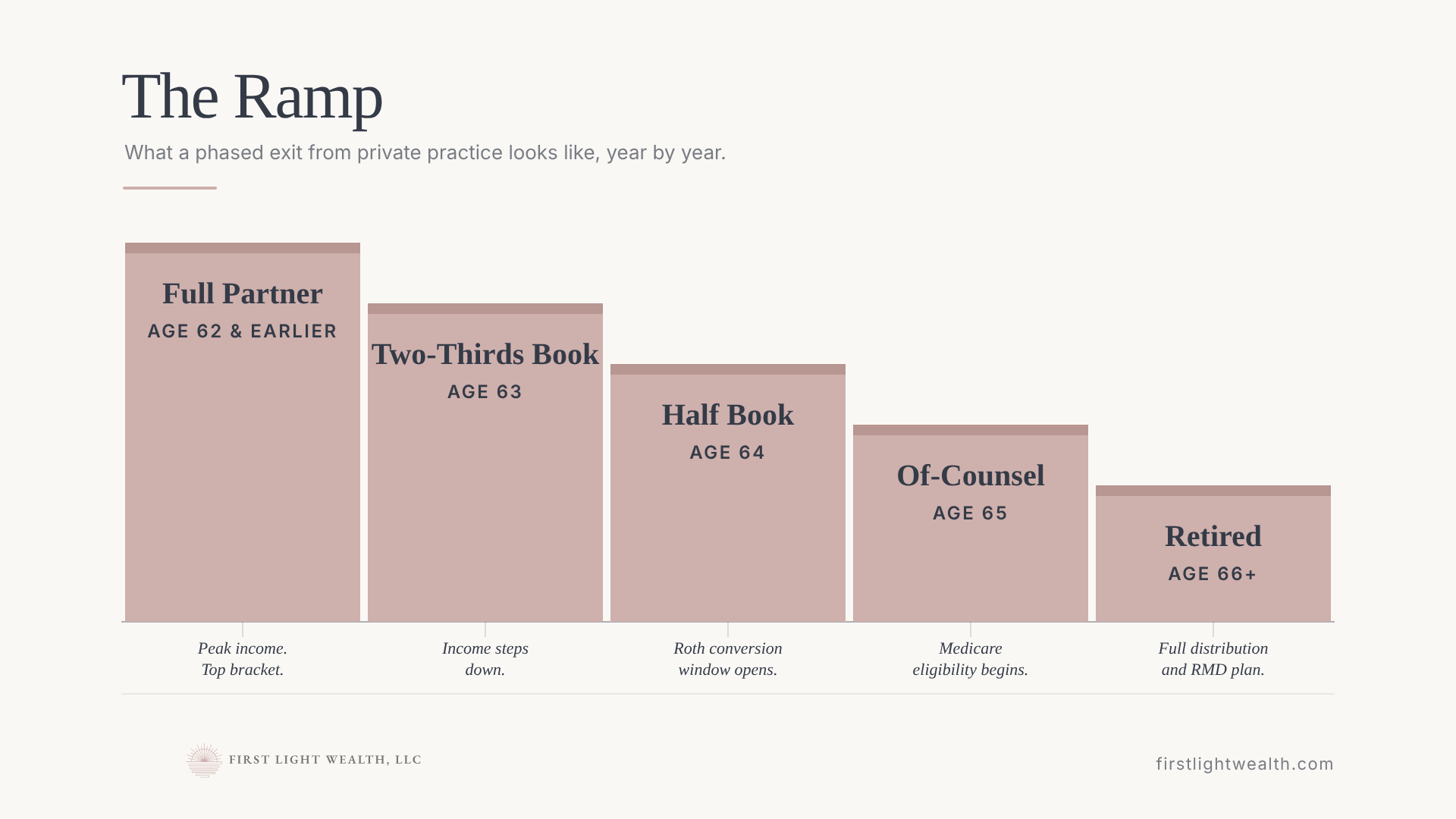
If you drop from full equity partner to a two-thirds book at 63, a half book at 64, and of-counsel at 65, every one of those steps is its own financial scenario. Your partner income changes. Your retirement plan contributions change. Your marginal tax bracket changes. Your health insurance potentially changes. What you may draw from taxable accounts versus pre-tax accounts changes along with all of it.
In my financial planning practice this gets called the ramp. Everyone pictures the top of the ramp (full practice) and the bottom (fully retired). The three or four years in between are where most of the planning lives. But that part is hard to conceptualize for most attorneys.
While you are earning full partner income, your marginal rate is sitting in the top brackets. Any Roth conversion you do now is expensive. Any pre-tax contribution is a bargain.
The year you drop to a half book, your marginal rate may fall by several points. A Roth conversion that would have been expensive at full income may now make sense. The window to move money out of pre-tax accounts at a lower rate, before Social Security kicks in and before Required Minimum Distributions start at 73 or 75 (depending on your date of birth), is often three or four years long. That window often closes afterward, though Roth conversions may still offer estate planning benefits even when the tax math suggests otherwise.
Many of the attorneys I work with were raised on the idea that you defer taxes until retirement and worry about it later. “Later” can turn out to be a 73-year-old with a large 401(k) and an RMD that pushes them right back into the top bracket. These are simply generalized examples, not advice aimed at your situation necessarily. Your numbers may be different.
If you are five years out, three questions are worth answering now.
First, who takes the clients. Specific people, specific matters, with introductions that start inside the next twelve months. Recruiters and consultants tend to agree on this: a last-minute handoff rarely holds, and a three-year handoff usually does.
Second, your income steps. What does your firm pay a half-book partner, an of-counsel, a contract attorney? If no one at the firm has those numbers, the firm has not planned for your exit either. And that information would be very beneficial to know.
Third, the money side on your end. What is the gross income you may need in each ramp year to maintain your lifestyle? Where does it come from across your accounts and income sources? What does each year’s tax bill look like? When does your Roth-conversion window open, and when does it close?
The hardest part of this is rarely the pretty charts and graphs that illustrate your retirement readiness.. Most of the attorneys I work with have built an identity around being a lawyer. The practice is the thing people ask about at dinner. Stepping back from it, even on your own terms, is a loss alongside the gain.
Nobody at your firm is going to pause for you to be ready.
Your partners want certainty.
Your clients want continuity.
Your family wants to know what the next chapter looks like.
The gift of starting early is that you get to shape all of that yourself, instead of having it shaped for you by a merger, an illness, or a Monday morning you did not see coming.
If you want to walk through what your own ramp could look like, you can Start A Conversation here and we will map it out together.
Cheers,
David
One short email a week on the money, taxes, and personal side of stepping away from the law.

Financial Advisor


Financial planning & investment management services for families & businesses
📍405 E Chocolate Ave, Suite 101 A, Hershey, PA 17033
Serving clients virtually nationwide