
.png)
When an attorney asks me whether they have enough to retire, the first thing I want to know is what they spend. Income comes later, and it usually matters a lot less than people expect.
Most planning starts from the other direction. Replace 70 or 80% of your income, back into a portfolio number, and there's your target. Easy to remember.
The problem is it also sends a lot of attorneys chasing a number their life doesn't cost.
Let's walk through the pieces that change.
The moment the paychecks stop, so do payroll taxes. Medicare runs on every dollar you earn, and above $250,000 (joint filers) of household income there's an extra 0.9% surtax riding along on top of it. Own your practice and you've been paying both halves of most of that.
Social Security tax (6.2%) runs on the first $184,500 in 2026. That won’t be there either in retirement.
At $500,000 that's real money leaving every month, and it goes away the day you do.
Social Security benefits then get taxed on their own schedule, anywhere from 0% to 85% of the benefit depending on what else you have coming in. Money coming out of a Roth account isn't taxed at all, and gains in a brokerage account are usually taxed at lower rates than your paycheck ever was.
Then there's your state. Some leave retirement income alone entirely, some tax it like anything else. Worth knowing which one you live in before you build a number around it. SmartAsset has a free retirement tax calculator that will get you in the neighborhood. It's my understanding these rules move around by state and by income level, so confirm the real number with your CPA.
Malpractice premiums. Bar dues. CLE credits. The parking spot downtown.
Sever completely and those disappear. Your mortgage may be gone by then too, or you've downsized and it's smaller.
Plenty of attorneys keep a foot in, of course, and some of those costs stay. The exercise is to walk each line and ask whether it survives the transition.
If you've been maxing the 401(k) with the catch-up, funding the profit sharing or cash balance piece, and sweeping what's left into a brokerage account, that can run north of $130,000 a year that never touched your life.
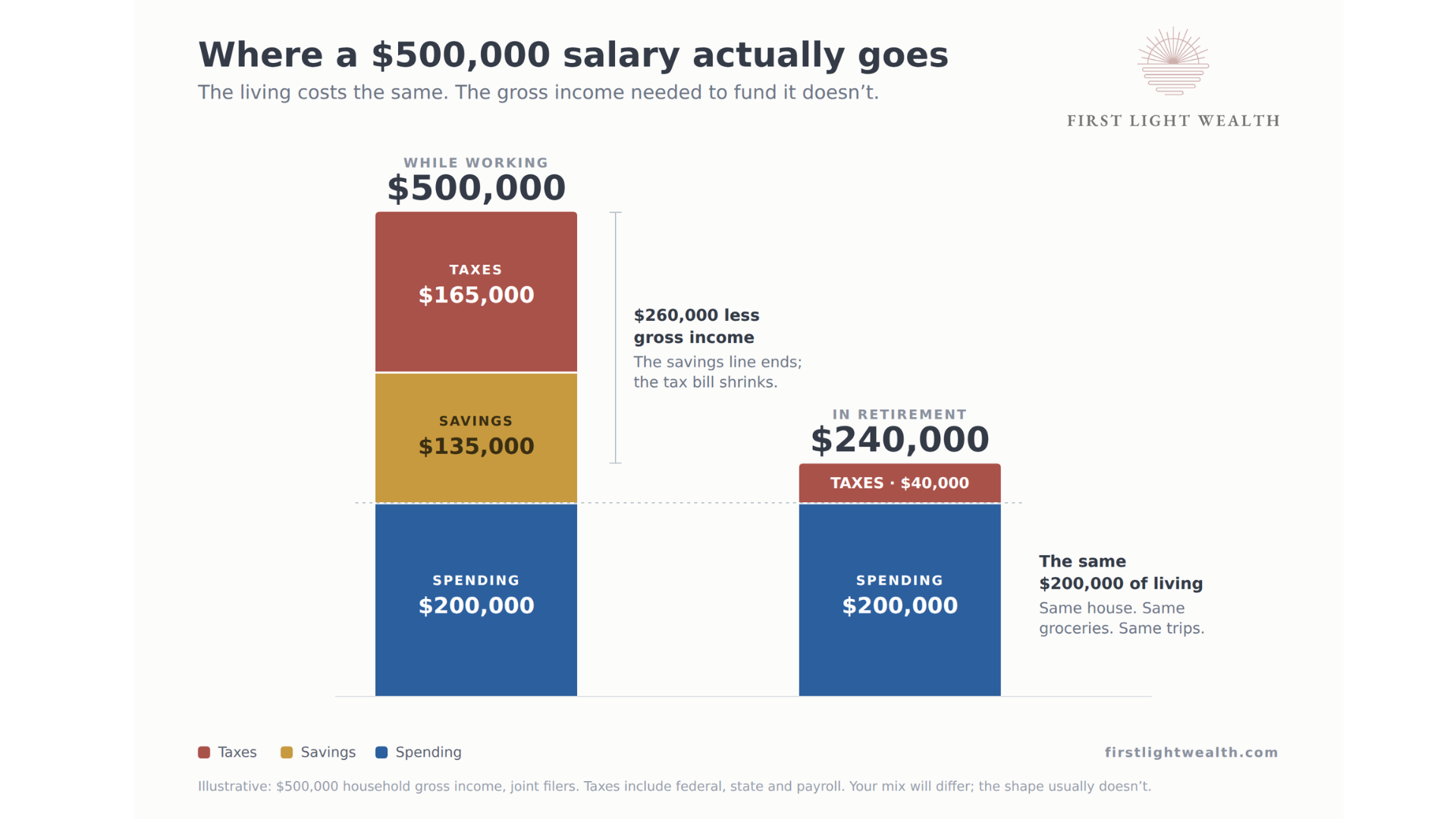
So here's the $500,000 broken into its real parts. Call it $165,000 across federal, state, and payroll taxes. Call it $135,000 into savings. What's left, and what you have actually been living on, is $200,000.
That $200,000 is spending money, and holding it up against a $500,000 gross salary isn't a fair fight. You still owe tax in retirement. The bill just tends to be a lot smaller, and it's built differently.
To put $200,000 in your pocket, we’ll estimate that this household needs to pull somewhere around $240,000 of gross income. Taxes take roughly $40,000 of it.
Now the comparison works. $500,000 of gross income before. About $240,000 after. Same house, same groceries, same trips.
The savings line went away, and the tax bill went from around $165,000 to around $40,000. That's where the other $260,000 went.
Your mix will be different, but the shape of it usually isn't.
There are two ways to get your spending number.
The first is top-down. Start with gross income, subtract what you paid in taxes, subtract what you saved. What's left is what you spent. Ten minutes with a tax return and a couple of statements. It tends to overshoot a little, which I'm fine with, because the cushion lands on the right side.
The second is bottom-up. Itemize every category. More precise in theory. In practice it comes in low, because you remember the mortgage payment and forget the annual furnace service and the wedding gift you'll be writing a check for in October.
Chances are your real number sits between the two. Start with top-down and you'll get there in an afternoon.
None of this means retirement is cheaper.
Plenty of people spend more once they finally have time to fill, and travel and grandchildren are not free. Apples to apples, keeping the same life going costs less than earning it did. What you do with that extra room is a separate conversation, and a good one to have.
Start with what you spend, then gross it back up for the tax bill. Everything else in the plan gets built on top of that number, and if it's wrong, so is everything else.
Next week I'll take that $240,000, subtract Social Security from it, and run what's left against a $3 million portfolio to see what happens.
If you'd rather not wait to find out where your own number lands, you can schedule a call with me here.
Enjoy your Labor Day Weekend!
-Dave

Financial Advisor


Financial planning & investment management services for families & businesses
📍405 E Chocolate Ave, Suite 101 A, Hershey, PA 17033
Serving clients virtually nationwide