
.png)
It's the end of August.
In about four months, every giving decision you make this year is going to happen at once. Pledge cards show up in November. The alma mater sends its annual appeal. And by the third week of December people are writing checks in a hurry because the calendar is running out.
That rush is where mistakes surface.
So let's have the conversation now, while there's still room to move.
Chances are you're taking the standard deduction. Most retirees are, ever since the deduction roughly doubled in 2017 and itemizers dropped from about 30% of filers to around 10%.
If that's you, a $20,000 check to your church produces zero federal tax benefit. The charity gets the money. Your tax return doesn't change at all.
And if you do still itemize, 2026 added a wrinkle. There's now a floor on charitable deductions, meaning the first 0.5% of your income in gifts isn't deductible. On $250,000 of income, that's the first $1,250 of your giving, gone, according to a summary of the new charitable rules.
I know how this sounds. You give because you want to give, not because of what it does on a tax return.
Fair enough. But if the same gift can also lower your tax bill, I'd rather you have both.
A Qualified Charitable Distribution works differently. The money goes straight from your IRA to the charity, and it never shows up as income.
It's my understanding that the IRS treats this as an exclusion from income rather than as a deduction, and that difference matters more than it sounds like it should.
A deduction lowers your taxable income. A QCD lowers your AGI, which is the number the rest of the tax code keeps checking.
Quite a few things are watching that number:
A Schedule A deduction doesn't touch any of that. Your AGI is already locked in by the time you get to Schedule A.
Let's say you and your spouse have $230,000 of income, and you give $20,000 a year between your church and your law school.
Write the checks the usual way and your income stays at $230,000. You're over the Medicare surcharge line, you're deep into the senior deduction phaseout, and you may get nothing back for the gifts at all.
Do that same $20,000 as a QCD and your income lands at $210,000. Same money, same charities, same year. But now you may be under the Medicare line, you may have clawed back part of that senior deduction, and less of your Social Security is exposed.
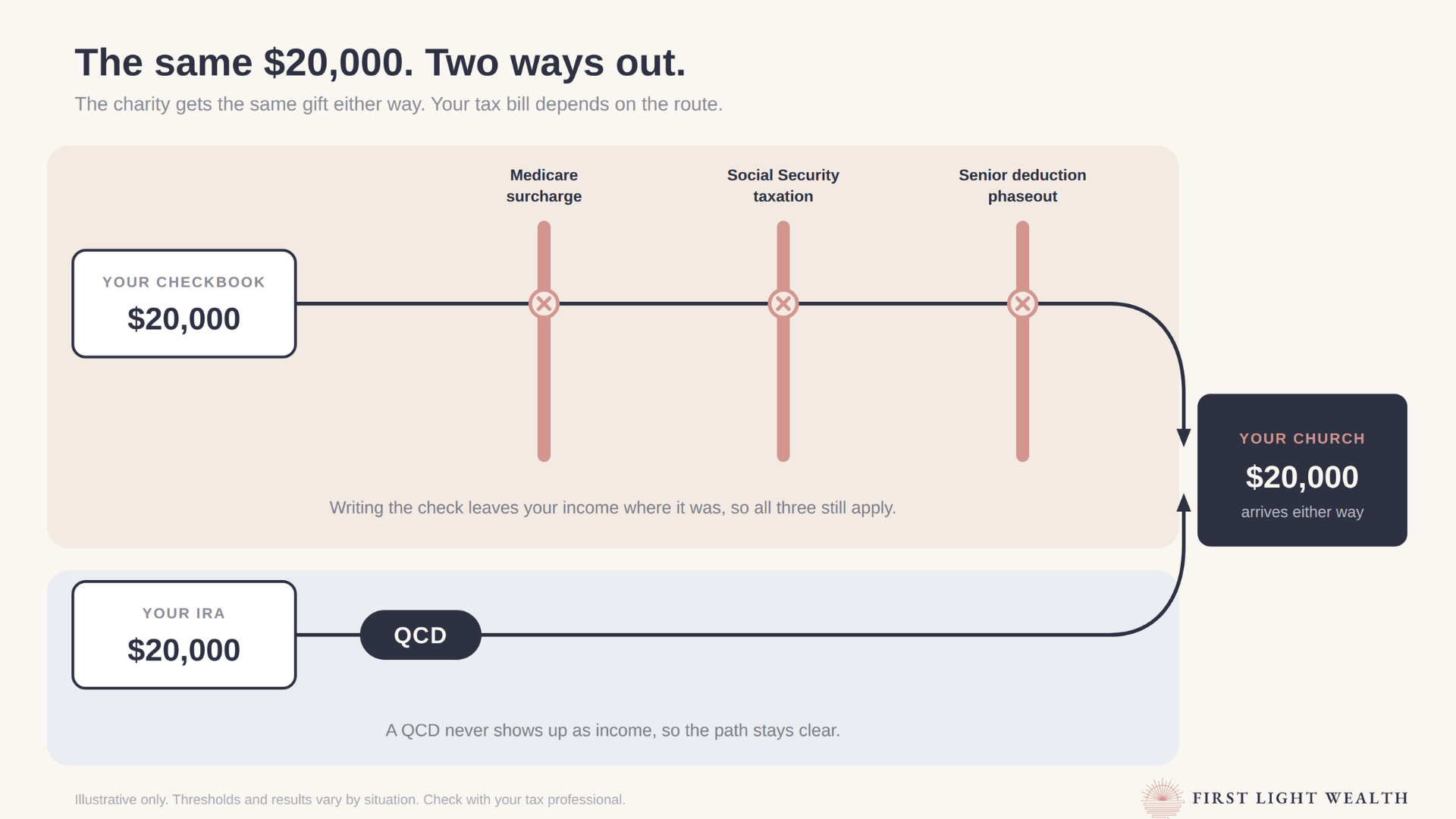
Again, these are just example numbers. Yours will look different, and this is worth running past your tax professional before you move anything.
You may also want to look at this if you're between 70½ and 73. QCDs become available at 70½. Required distributions don't start until 73. Those few years are a quiet window to shrink the IRA before the IRS starts telling you how much to take out of it.
The money has to go directly from your custodian to the charity. If a check comes to you first and you write your own check to the church, the whole thing stops working.
And the first dollars out of your IRA in a given year count toward your required distribution. So if you want the QCD to cover your RMD, it has to happen before you take anything else out.
For 2026 you may give up to $111,000 per person this way. Per person, not per couple, so you and your spouse each have your own limit.
None of this makes deducting wrong, by the way. If you're giving appreciated stock, or bunching several years of gifts into one big itemizing year, that math can still win. QCDs also can't fund a donor advised fund, so if that's your vehicle, this isn't the tool.
November is a bad time to figure this out. Custodians get slow, the deadline is real, and a transfer that doesn't clear by December 31 doesn't count for the year.
You've got four months.
If you're giving anyway and you're past 70½, this is worth a look now instead of in a rush later. If you'd like to see what it would mean for your own numbers, click below and let's find some time.
Cheers,
David

Financial Advisor


Financial planning & investment management services for families & businesses
📍405 E Chocolate Ave, Suite 101 A, Hershey, PA 17033
Serving clients virtually nationwide